
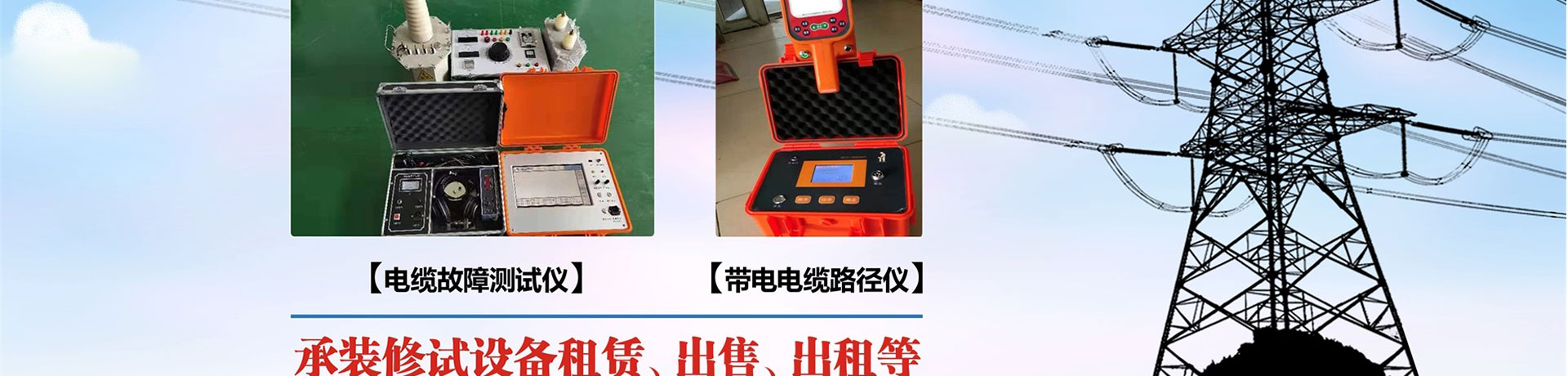
It is used to detect various faults in cable lines, such as short circuits, open circuits, and ground faults. The following is an article about cable fault locators, aiming to introduce their basic concepts, working principles, applications, and development trends.
Overview of Cable Fault Locator
Basic Definition
A cable fault locator is a professional device used to detect faults in power cables, such as insulation breakdown, broken conductors, and poor grounding. These faults can lead to serious consequences like power supply interruptions, equipment damage, or even fires, making timely detection and troubleshooting crucial.
Importance
Cable fault locators play a vital role in the maintenance of power systems. They can quickly and accurately locate cable fault points, helping technicians promptly repair issues, restore power supply, and reduce economic losses.
Working Principle
Testing Methods
Cable fault locators typically employ the following testing methods to detect faults in cables:
Low Voltage Pulse Reflection Method (LPRF): Suitable for finding open circuits, short circuits, and low-impedance faults. It sends low-voltage pulses into the cable and captures the reflected signals, calculating the fault distance based on the signal round-trip time.
High Voltage Flashover Method (HVFL): Used for detecting high-impedance faults. It applies high voltage to cause discharge at the fault point, capturing the discharge waveform to locate the fault.
Audio Frequency Method: Utilizes an audio signal transmitter to send a specific frequency audio signal into the cable, and a receiver along the cable path to trace the cable route and determine the fault location.
Testing Steps
Preparation: Turn off the power and ensure the cable is de-energized.
Select the appropriate method: Choose the suitable testing method based on the cable type and the estimated nature of the fault.
Execute the test: Perform the test operation according to the selected method.
Data analysis: Analyze the test data to determine the fault type and location.
Fault location: Combine with other detection means (such as the audio frequency method) to finally determine the exact location of the fault.
Application Fields
Cable fault locators are widely used in power engineering, communication networks, railway transportation, and many other fields. Whether it is the acceptance testing of new cable lines or the maintenance of existing cable lines, these instruments are needed to accurately and quickly identify potential problems for timely repair.
Usage Precautions
Safety first: Ensure the cable is de-energized before testing and comply with all safety operating procedures.
Precisely select test parameters: Choose appropriate test voltage and current according to the specific conditions of the cable.
Interpret test results correctly: Understand the test results properly to avoid misjudgment.
Regularly calibrate the instrument: Ensure the accuracy of the tester and extend its service life.
Development Trends
With technological advancements, cable fault locators are continuously innovating:
Intelligence: Integrating more sensor technologies for remote monitoring and data analysis.
Portability: Smaller size, lighter weight, and easy to carry.
Multi-functionality: In addition to fault detection, adding functions such as cable identification and depth detection.
Energy saving and environmental protection: Adopting low-power designs to reduce energy consumption.
In summary, cable fault locators are indispensable tools in power system maintenance. With continuous technological development, future cable fault locators will become more intelligent and portable, providing stronger support for the safe and stable operation of power systems.