
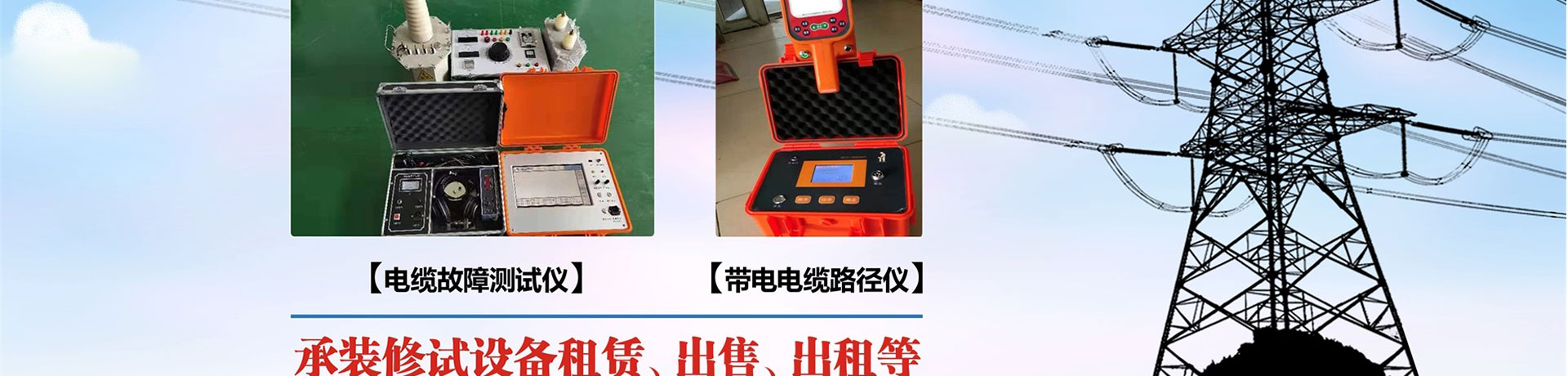
Basic Concept: A cable fault tester sends specific signals into the cable and analyzes the returned signals to determine the location of the fault.
Implementation Methods:
Time Domain Reflectometry (TDR): Sends a pulse signal into the cable and determines the fault location based on the time and amplitude of the reflected signal.
Pulse Current Method: Injects a high-energy pulse current into the cable and uses sensors to detect electromagnetic waves or acoustic waves generated at the fault point to locate the fault.
High Voltage Flashover Method: Applies a high-voltage pulse to cause a flashover discharge at the fault point, and uses the signal generated by the flashover to locate the fault.
Low Voltage Pulse Method: Suitable for low-resistance faults, sends low-voltage pulse signals and analyzes the reflected waveform to locate the fault.
Audio Frequency Method: Sends audio frequency signals and uses a receiver to trace the signal, suitable for fault location in long-distance cables.
Types
Portable Cable Fault Testers: Small size, lightweight, suitable for on-site rapid testing, usually powered by built-in batteries.
Benchtop Cable Fault Testers: Suitable for laboratory environments, providing higher accuracy and more functional options.
Multifunctional Integrated Testers: In addition to basic fault location functions, they also have data recording, analysis, and other functions, forming a complete testing solution.
Specialized Cable Fault Testers: Designed for specific types of cables (such as power cables, communication cables), with targeted functions and performance optimization.
Application Areas
Power Industry: Fault detection and location for cables in transmission lines and distribution lines.
Communication Industry: Fault detection for communication cables such as fiber optic cables and telephone lines.
Construction Industry: Fault detection for wires and cables inside buildings.
Railway Transportation: Fault detection for railway signal cables and power cables.
Mining Industry: Fault detection for cables in mines.
Oil and Gas Industry: Fault detection for cables in oil fields and natural gas pipelines.
Municipal Engineering: Fault detection for cables in urban infrastructure.
Advantages
High Efficiency and Accuracy: Modern cable fault testers use advanced sensing technology and algorithms to quickly and accurately locate fault points.
Easy Operation: Most models are equipped with user-friendly interfaces and automatic calibration functions, simplifying the operation process.
Multifunctionality: Some advanced models have additional functions such as data recording and analysis besides basic fault location.
Good Safety: Equipped with overload protection mechanisms and other safety measures to ensure the safety of operators.
Strong Adaptability: Suitable for various types of cables and different fault types.
Usage Precautions
Correct Selection: Choose the appropriate model and specification according to specific application needs to ensure the equipment matches the actual working conditions.
Correct Connection: Strictly follow the instructions to connect all lines, ensuring good contact and no risk of short circuits.
Regular Calibration: To ensure data accuracy, the instrument should be regularly sent back to the manufacturer or a professional institution for calibration.
Comply with Safety Regulations: When working in high-voltage environments, appropriate safety protection measures must be taken, such as wearing insulating gloves and boots.
Warm-up Time: Some high-end instruments require a certain warm-up time to achieve optimal performance; please refer to the recommendations in the manual.
Data Analysis: Carefully analyze test results, identify and solve problems in a timely manner to ensure the safe and reliable operation of cables.
Environmental Conditions: Avoid using in humid or dusty environments to prevent affecting equipment performance.
Conclusion
Cable fault testers are indispensable and important tools in power system maintenance, communication network repair, and other industries involving cables. They can not only quickly and accurately locate fault points but also improve work efficiency and safety. With the development of technology, future cable fault testers will become more intelligent and portable, providing users with more convenience. Correctly selecting an appropriate tester and mastering the correct usage methods are crucial for obtaining reliable test results.
I hope this article provides you with a comprehensive understanding of the basic knowledge and importance of cable fault testers. If you have any specific questions or want to learn more details, please feel free to let me know!