
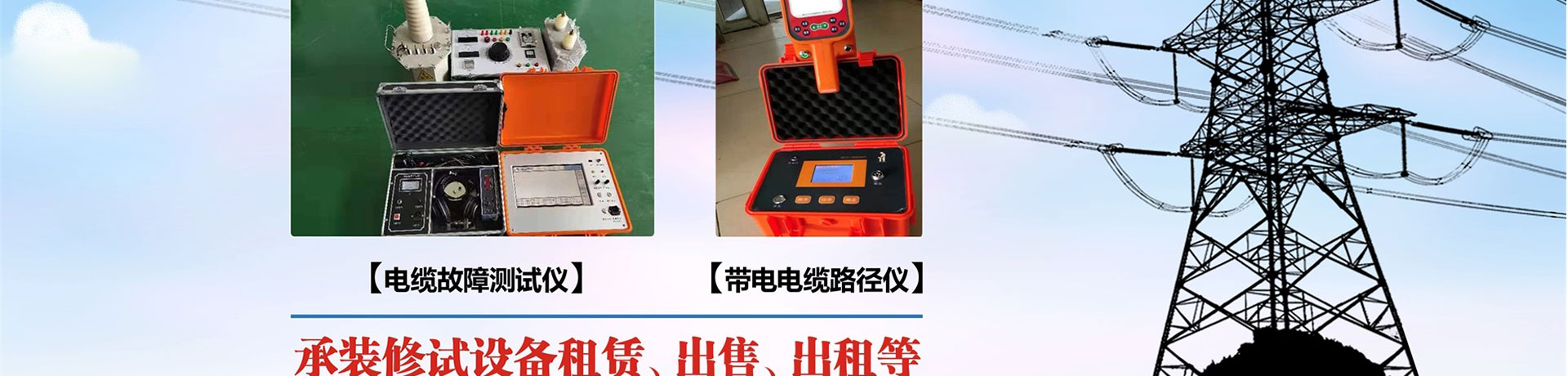
Cable fault location is a critical task, especially in power systems, where quickly and accurately locating cable fault points is essential for restoring power supply and ensuring the safe operation of the power system. Below is an overview of an article about cable fault location, particularly the precise determination of the distance to the fault point:
Fault location: precisely determining the distance to the fault point
Introduction
Cable fault location is an important task in power system maintenance, helping technicians quickly find fault points in cables, thereby speeding up the repair process and reducing outage time. Precisely determining the distance to the fault point is one of the key steps in this process.
Methods of fault location
Pulse reflection method (TDR): Determines the location of the fault point by sending high-frequency pulse signals to the cable and analyzing the returned signals.
Acoustic-magnetic synchronization method: Combines sound and magnetic field signals to locate the fault point.
Audio induction method: Sends audio signals to the cable and uses a detector to trace the cable path and locate the fault point.
Voltage drop method: Suitable for low-voltage cables, estimating the approximate location of the fault point by measuring voltage drops.
Detailed explanation of the pulse reflection method (TDR)
Principle: The pulse reflection method (Time Domain Reflectometry, TDR) is a commonly used cable fault location technique. It determines the distance to the fault point by sending a short pulse signal to the cable and measuring the time difference from transmission to return of the pulse.
Operational steps:
Connect the tester: Connect the cable fault tester to one end of the cable.
Send the pulse: The tester sends a pulse signal to the cable.
Receive the reflected signal: The tester receives the signal reflected back from the other end of the cable or the fault point.
Calculate the distance: Calculate the distance to the fault point based on the round-trip time of the pulse signal and the velocity factor of the cable.
Advantages:
Quickly locates the fault point.
Testing can be performed without interrupting power supply.
Can detect multiple faults simultaneously.
Limitations:
For certain types of faults, such as high-impedance faults, accurate location may be difficult.
Changes in the characteristic impedance of the cable may affect test results.
Acoustic-magnetic synchronization method
Principle: The acoustic-magnetic synchronization method combines sound and magnetic field signals to locate the fault point. This method is suitable for fault location in high-voltage cables.
Operational steps:
High-voltage discharge: Generate sound and magnetic field signals at the fault point through high-voltage discharge.
Signal detection: Use detectors to capture the sound and magnetic field signals generated at the fault point.
Synchronized location: Determine the position of the fault point by comparing the time differences of signal arrivals at the detectors.
Advantages:
Can precisely locate high-impedance faults.
Suitable for fault location in long-distance cables.
Limitations:
Requires applying high voltage to the cable, which may pose safety hazards.
Sensitive to environmental noise.
Application cases
Case 1: Successfully located a short-circuit fault point in a medium-voltage cable using the pulse reflection method, reducing repair time.
Case 2: Located a high-impedance fault in a high-voltage cable using the acoustic-magnetic synchronization method, avoiding a large-scale power outage.
Conclusion
Precisely determining the distance to cable fault points is key to ensuring the safe operation of power systems. By using advanced testing techniques and equipment, fault points can be effectively located, thereby reducing outage time and maintenance costs. The pulse reflection method and the acoustic-magnetic synchronization method are two commonly used fault location techniques, each with its own advantages and disadvantages, and the appropriate method can be chosen based on specific circumstances.
The above provides an overview of cable fault location methods and their application cases. If you need more specific information or have other questions, please feel free to let me know, and I will do my best to help.