
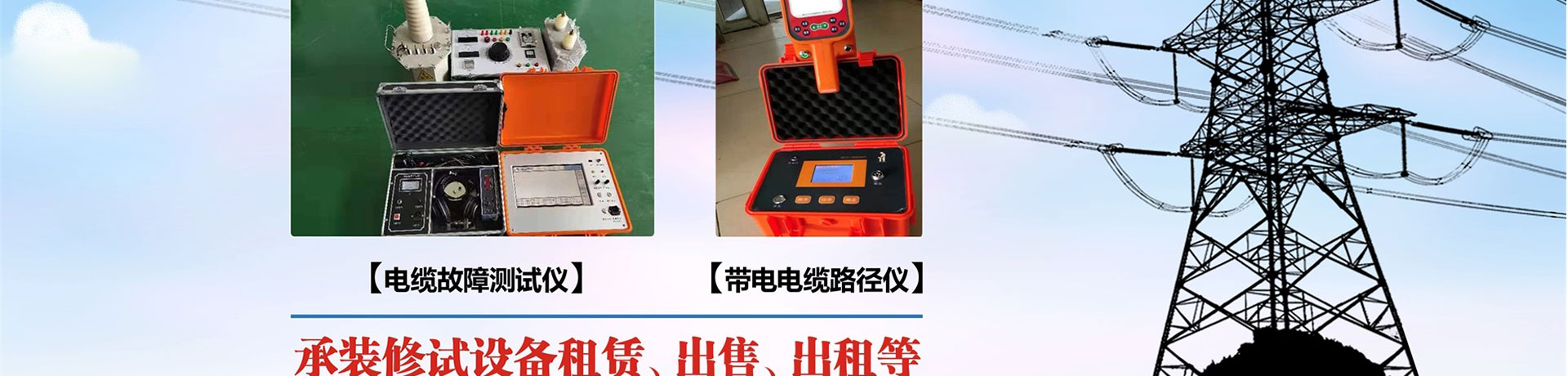
A Lightning Counter Calibrator / Tester is a portable specialized instrument designed for detecting and maintaining discharge counters (typically installed at the base of surge arresters).
Its primary function is to simulate real lightning current impulses, verifying whether the discharge counter operates accurately, whether the count resets to zero or accumulates correctly, thereby ensuring the reliability of the surge arrester monitoring system.
Below is a detailed introduction to this instrument:
1. Core Functions
Functional Verification: Simulates high-current pulses from lightning strikes to check whether the counter's mechanical transmission mechanism is stuck or electronic components are damaged.
Accuracy Testing: Verifies whether the counter can accurately record one count (i.e., "move once") when subjected to a standard impulse current.
Reset Testing: Some advanced instruments, combined with specific operations, can test the counter's reset-to-zero function (depending on the counter model).
Preventive Testing: As part of preventive testing for power equipment, it ensures that after actual lightning storms, maintenance personnel can determine whether the surge arrester has operated based on the counter reading.
2. Working Principle
The lightning counter calibrator is essentially a portable high-current pulse generator.
Energy Storage: The instrument contains a high-voltage capacitor energy storage circuit.
Waveform Simulation: By controlling the discharge circuit, it generates an impulse current with an 8/20μs waveform (wavefront time 8 microseconds, time to half value 20 microseconds) as specified by national standards (e.g., IEC 60099-4 or GB/T 11032).
Current Injection: The simulated lightning current (typically adjustable in amplitude, ranging from 100A to 2000A or higher) is directly injected into the input terminal of the discharge counter.
Operation Determination: Observe whether the counter pointer jumps one division. If one standard current injection causes the counter to operate once, it is deemed qualified.
3. Main Technical Specifications
Output Current Waveform: Standard 8/20μs lightning current waveform.
Output Current Amplitude: Typically adjustable within the range of 100A to 2000A (common test points are 500A, 1000A, 2000A).
Note: Different counter models have different operating thresholds; generally, they are required to operate reliably at 100A-500A.
Charging Time: Fast charging, usually taking a few seconds to about ten seconds to prepare for one test.
Power Supply: Built-in rechargeable lithium battery, convenient for field operations without external power.
Weight and Dimensions: Lightweight design, typically weighing 3-5kg, easy for one person to carry while climbing poles or operating on the ground.
Safety Protection: Equipped with overvoltage, overcurrent, short-circuit protection, and audible/visual alarms.
4. Operating Procedure (General Steps)
Safety Measures:
Ensure the surge arrester and counter are in a de-energized state (although the counter is on the low-voltage side, for safety, it is usually recommended to perform the test after the surge arrester is de-energized or with proper insulation isolation).
Wear insulating gloves and stand on an insulating mat.
Wiring:
Connect the high-voltage output wire (red) of the calibrator to the high-voltage input terminal of the counter (i.e., the end connected to the lower part of the surge arrester).
Connect the ground wire (black) of the calibrator to the counter's grounding terminal (or a reliable earth ground).
Note: It is necessary to disconnect the counter from the surge arrester and the ground grid, isolating the counter for individual testing, or use special clamps for parallel testing (refer to the specific instrument manual; the series injection method is usually recommended).
Parameter Setting:
Turn on the instrument and set the desired impulse current value (e.g., set to 500A or 1000A).
Executing the Test:
Press the "Test" or "Discharge" button.
The instrument emits a "pop" discharge sound and outputs the impulse current.
Result Reading:
Immediately observe the counter reading.
Acceptance Criteria: Each impulse applied should increase the counter reading by 1.
It is usually recommended to test 3-5 times consecutively to rule out occasional sticking.
Restoring Operation:
After testing, remove the test leads.
Restore the normal connections of the counter to the surge arrester and the ground grid.
Record test data (test time, current value, operation status).
5. Common Fault Diagnosis
No Operation:
Internal mechanical jamming or gear damage in the counter.
Coil burnout or electronic module failure.
Test current not reaching the operating threshold (increase the current and retry).
Multiple Jumps or Overcounting:
Internal contact sticking.
Mechanical return spring failure.
Unclear Reading:
Water ingress causing fogging in the glass cover, or aging of the dial; the counter needs replacement.
6. Precautions
Strictly Prohibit Live Testing: Although the counter is on the low-voltage side, ensure the surge arrester body is not energized during testing, and preferably disconnect the counter from the circuit to prevent high-voltage back-strike from damaging the calibrator or endangering personal safety.
Current Limitation: Do not frequently use the maximum current (e.g., 2000A) for extended periods to avoid damaging the internal coil of sensitive counters. Generally, start with a low current (e.g., 300A-500A) for testing.
Reliable Grounding: The calibrator itself and the test circuit must be properly grounded to prevent injury from induced voltage.
Periodic Calibration: The calibrator itself is a measuring instrument and must be regularly sent to a metrology institute for calibration to ensure the accuracy of the output current waveform and amplitude.
7. Application Scenarios
Before the Thunderstorm Season: Conduct a general survey of all surge arrester counters in the jurisdiction to ensure effective monitoring.
After Thunderstorms: If a counter has operated, use the calibrator to verify whether it still works properly or to confirm whether it was a false operation.
New Equipment Commissioning: Perform on-site acceptance tests after installing new surge arresters and counters.
Fault Troubleshooting: When inspections reveal abnormal counter readings (e.g., unchanged for a long time or sudden changes), perform diagnostics.
Summary
The lightning counter calibrator is a key tool for ensuring the proper functioning of the surge arrester's "black box." By simulating lightning current, it verifies the health of the counter in a low-cost, high-efficiency manner. For the power system, an accurate counter helps maintenance personnel determine whether the surge arrester has been struck by lightning, whether it needs repair or replacement, and is an indispensable part of lightning protection management.
.jpg)