
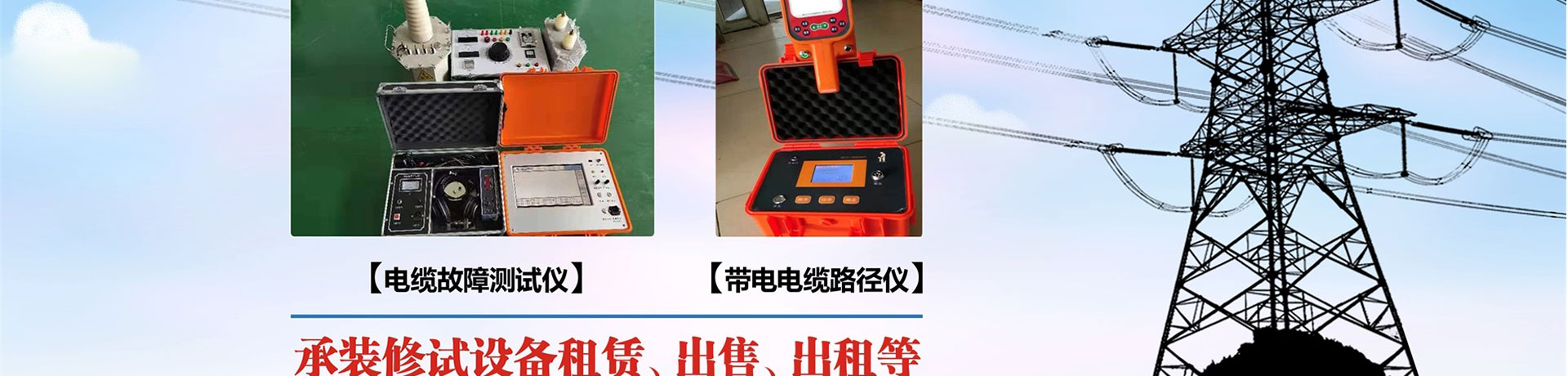

 For the detection of low-voltage cable fault points, it generally goes through three main steps: fault type diagnosis, fault point distance measurement, and precise pinpointing. Fault type diagnosis mainly determines the faulty phase of the cable fault point, whether it is high-resistance grounding or low-resistance grounding, so that testers can choose appropriate detection methods. Fault point distance measurement, also called pre-location, involves applying test signals to the faulty cable core wire or performing online measurement and analysis of fault information to preliminarily determine the fault distance, narrowing down the fault range to facilitate precise pinpointing. Wuhan Huayi Electric Power Technology Co., Ltd. (abbreviated as: Huayi Electric Power) is a manufacturer of power test equipment under the national power system. The independently developed series of equipment products are widely used in industries such as electric power, water conservancy, petroleum, railway, mining, and chemical engineering, and have received unanimous praise and favor from users!Low-voltage cables refer to power cables with a working voltage of less than 1kV. They consist of an insulation layer and a protective layer. They are used to connect cables from distribution cabinets to equipment terminals. Compared with high-voltage cables, low-voltage cables are richer in technical structure and usage. The scope is also different; both are carriers for conducting electrical energy, and their usage range is ubiquitous. When a cable fault occurs, we first try to solve the fault and restore operation. In addition, we must analyze the cable fault to identify the specific cause. According to data from the after-sales service department of Dingsheng Electric, cable quality issues can be ruled out. There are two main reasons for low-voltage cable faults. One is external factors causing damage to the outer insulation, leading to grounding faults due to moisture. The other is improper joint handling, causing short-circuit faults due to moisture. After a cable fault occurs, first use a multimeter or electronic megohmmeter to analyze the current fault situation through data. Check which phase has the cable fault. After determining the faulty phase, use a multimeter to measure the resistance to ground. If the measured resistance is greater than 200 ohms, the step voltage method is applicable to cable faults of all voltage levels for grounding faults. It is a method that uses the voltage between two feet around the grounding current entry point to find cable faults. The specific wiring method is that the red clip of the power cable fault detector connects to the faulty phase of the cable under test, the black clip connects to ground, then connect the path induction magnetic rod and the step voltage sampler, and turn on the power. After a brief synchronization signal, the host emits electromagnetic pulses, and the magnetic rod receiver searches along the road. It can accurately check the cable path, and then perform cable fault location along the found path. The specific method is to mark the left and right ends of the step voltage sampler with red and green respectively, and the indicator lights correspond accordingly. Insert the indicator marks of the step voltage sampler into the soil. The red and green directions of the indicator lights represent the direction of the cable fault point. If encountering a hard road, watering can also measure accurately. The right side indicates, and so on, to determine the fault point. Use the APP to get a first-hand experience immediately. There may be answers in your phone's camera that others want to know.